Organizers
Dor Abrahamson (UC Berkeley)
Catalina Lomos (LISER)
Presenters and Collaborators
Jean Botev (University of Luxembourg)
Thiago Quaresma Brant Chaves (LISER)
Justin Dimmel (University of Maine)
Katalin Gárdonyi (EduGameTech)
Alexander Refsum Jensenius (RITMO)
Magdalena Kotek (LISER)
Christian Lamy (IFEN)
Thibaud Latour (LMDDC)
Attila Lengyel (EduGameTech)
Valérie Maquil (LIST)
Aline Muller (LISER)
Luc NIJS (University of Luxembourg)
Alik Palatnik (Hebrew University of Jerusalem)
Matthew Patterson (University of Maine)
Julien Putz (UC Berkeley)
Manon Schroeder (LISER)
Katarzyna Potega vel Zabik (Copernicus Science Centre)
In Their Hands workshop series
As researchers, we are increasingly using emerging technologies, such as multiple mobile eye tracking, virtual reality, and physiological indicators (e.g., heart rate and respiration) to study professionals’ individual and collaborative work practices. In this workshop, we will demonstrate how these technologies can be provided to professionals in various fields (e.g., education, healthcare, business, engineering, the arts) as a resource for self-reflection, enabling them to study and improve their own practices.
The goal of this workshop is to introduce and facilitate participants to experience novel approaches that use these emerging technologies and tools to help practitioners study their own skills and understand their learning processes. We will also show how focus groups and stimulated recall interviews can encourage and guide professionals to discover ways to incorporate these new technologies into their practice as resources for reflection and growth.
The workshop’s theme is educational practice and research, with a focus on showing how we can offer teachers theoretically driven and empirically validated methodologies for witnessing the micro-processes of collaborative mathematics learning. We will show and discuss how multiple mobile eye-tracking and virtual reality can be used in educational practice and for teacher training and professional development.
This approach and these emerging technologies are applicable not only in education, but also in all other fields of research that aim to study individual and collective practices, as well as professional learning, during the process of acquiring new skills or improving existing ones.
Day 1 – 09/09/2025 – Multiple Mobile Eye Tracking and Stimulated Recall Interviews
Presenters: Dor Abrahamson, Alik Palatnik, Catalina Lomos
We will show how researchers can help professionals use multiple mobile eye tracking coupled with a stimulated recall interview to draw implications for their work and professional development. Participants will observe live data collection and visualization using this approach. Presentations of previous outcomes will be given, and discussions about the practical and methodological use of the approach will be held.
Day 2 – 10/09/2025 – Virtual Reality Tasks, Co-Design, and Focus Groups
Presenters: Dor Abrahamson, Justin Dimmel, Thibaut Latour, Catalina Lomos, Matt Patterson
We will show how researchers can help professionals use virtual reality tasks coupled with a focus group to draw implications for their work and professional development. Participants will observe live data collection using this approach. Presentations of previous outcomes will be given, and discussions about the practical and methodological use of the approach will be held.
Day 3 – 18/09/2025 – Physiological Indicators and Multidisciplinary Studies of Human Multimodality
Presenters: Dor Abrahamson, Jean Botev, Alexander Jensenius, Catalina Lomos
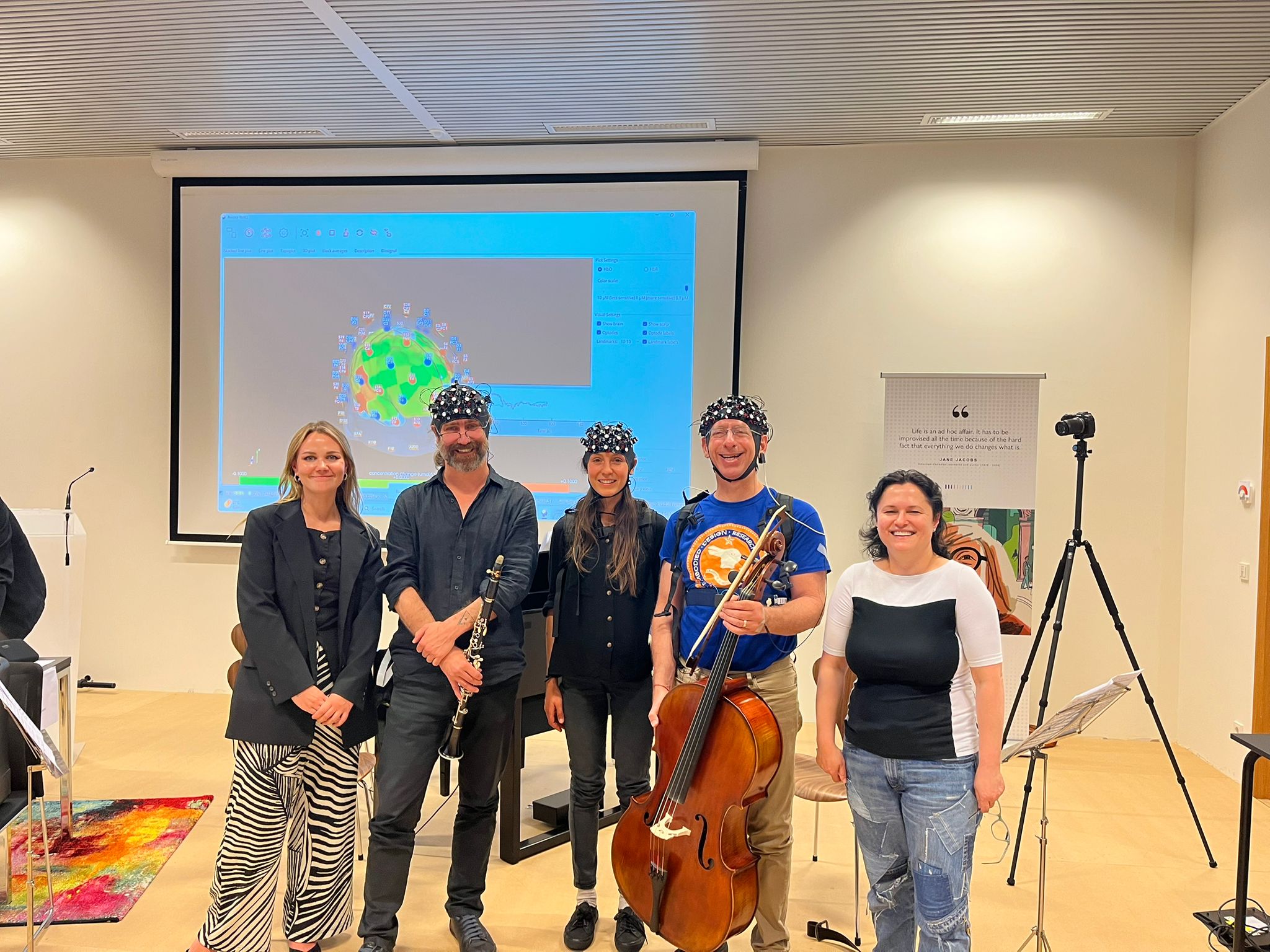
In this session, we will show and discuss the possibilities and limitations of multidisciplinary studies of human multimodality by combining methods from different disciplines. We will show how we leverage qualitative emerging technologies and methodological approaches to study humans and provide insights for AI development. Participants will observe live data collection using physiological indicators. Presentations of previous outcomes will be given, and discussions about the practical and methodological use of the approach will be held.
Meaningful Mathematics — an Enduring Educational Objective in the Digital Age
Presenter: Dor Abrahamson
If a nation hopes to compete in the global economy by cultivating a techno-scientifically capable workforce, what fundamental principles and methods should guide its educational stakeholders? Specifically, as Generative AI is rapidly supplanting our civilization’s engineering and creative experts, what might we wish for our youth to know so as to remain relevant? What should they learn, and how should they learn it? Could we imagine a world in which citizens do not — need not — understand the very meaning of the arithmetic operation addition, as in “3+2=5”?
Building on the premise that digital machines should and will extend rather than eliminate human minds, and that, therefore, humans should develop deep understandings of mathematical concepts, I invite the audience on an interactive journey to experience and overcome tensions between, on the one hand, our evolutionary capacity to perform simple perceptual judgments, and, on the other hand, the cultural-historical forms our ancestors have devised to augment those innate intuitions. Using the infamously counterintuitive domain of basic probability, I will engage you in a simple exercise demonstrating the essential questions of constructivist pedagogy and, hopefully, some useful answers to those questions. Ultimately, I will be advocating for a dialogic education that fosters students’ meaningful appropriation of mathematical procedures.
The presentation will explain the motivation, rationale, development, and evaluation of an experimental activity designed for students to appreciate quantitative analysis as both resonating with and expanding their epistemic evolutionary endowment.
Video Visualization – Learn to use MG Toolbox
Presenter: Alexander Refsum Jensenius
This workshop is targeted at students and researchers working with video recordings You will learn to use MG Toolbox, a Python package with numerous tools for visualizing and analyzing video files. This includes visualization techniques such as motion videos, motion history images, and motiongrams; techniques that, in different ways, allow for looking at video recordings from different temporal and spatial perspectives. It also includes some basic computer vision analysis, such as extracting quantity and centroid of motion, and using such features in analysis.
MG Toolbox for Python is a collection of high-level modules that generate all of the above-mentioned visualizations.The toolbox is relevant for everyone working with video recordings of humans, such as in linguistics, psychology, medicine, human-computer interaction, and educational sciences.
Target audience
Everyone interested in video analysis.
Learning outcomes
Learn to generate various types of visualizations from video recordings.
Prerequisites and required materials
Basic knowledge of Python and Jupyter Notebook.
Laptop with Python and Jupyter Notebook installed.
More Than Meets the Eye: First-Person Methods
Presenter: Julien Putz
Across the mind sciences, first-person reports are already woven into everyday practice—from button-press self-ratings to open interviews—yet they rarely receive sustained methodological attention. This talk asks how we can elicit and integrate them better. I introduce micro-phenomenology as a disciplined way to obtain fine-grained descriptions of lived experience and exemplify it with pilot studies on mathematical cognition, especially problem solving and proof comprehension. I argue that structured first-person inquiry can render learning theories more meaningful for learners and illuminate tacit dimensions of (mathematical) expertise. Brief vignettes illustrate how these descriptions can be aligned with co-registered gaze and interaction traces to support analysis and validation. While the cases come from mathematics education, the methodological issues—how to elicit, analyze, and integrate first-person data—are relevant across research on mind, learning, and behavior.
Additional resources
Click here for the LISER events page.
Click here for a LinkedIn post.
Photos


