Projects

"Kinemathics": Kinetically Induced Mathematical Learning

UCB Committee on Research: Faculty Research Grants, 2008-11 [$21k]
White PaperResearch-Group("White-Paper")
Conf. Proc:  AERA2010(Empirical),  PME-NA2010(Empirical),  PME-NA2010(Design)AERA2011(Hooks-and-Shifts)AERA2011(Embodied-Learning-Symp), SIGCHI2011IDC2011, CSCL2011, PMENA2011, AERA2012(+x), AERA2012(tutor), ICLS2012-symp, ICLS2012-paper
Journal ArticlesTechnology, Knowledge, and Learning (hooks and shifts),
Technology, Knowledge, and Learning (fostering hooks and shifts)

Video ClipsMechanical-MITElectronic-MITCyTSE2011
Chapters: MEDEra

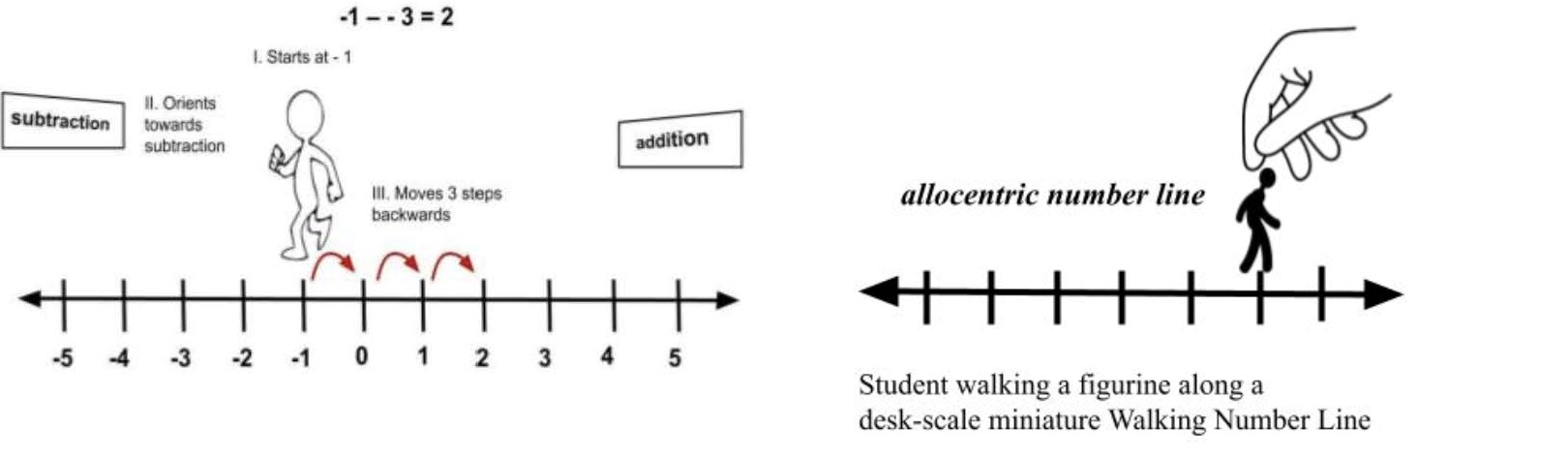
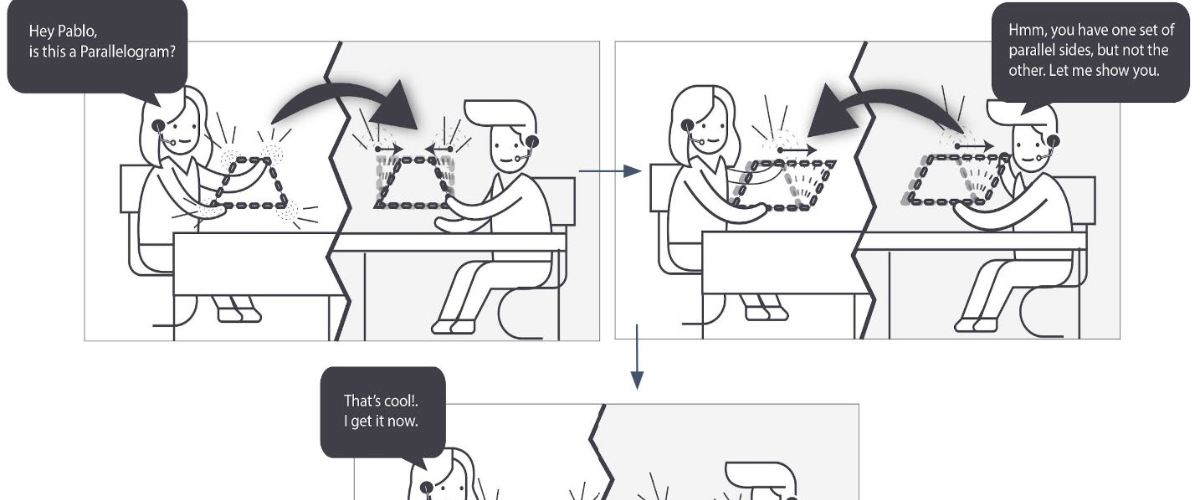
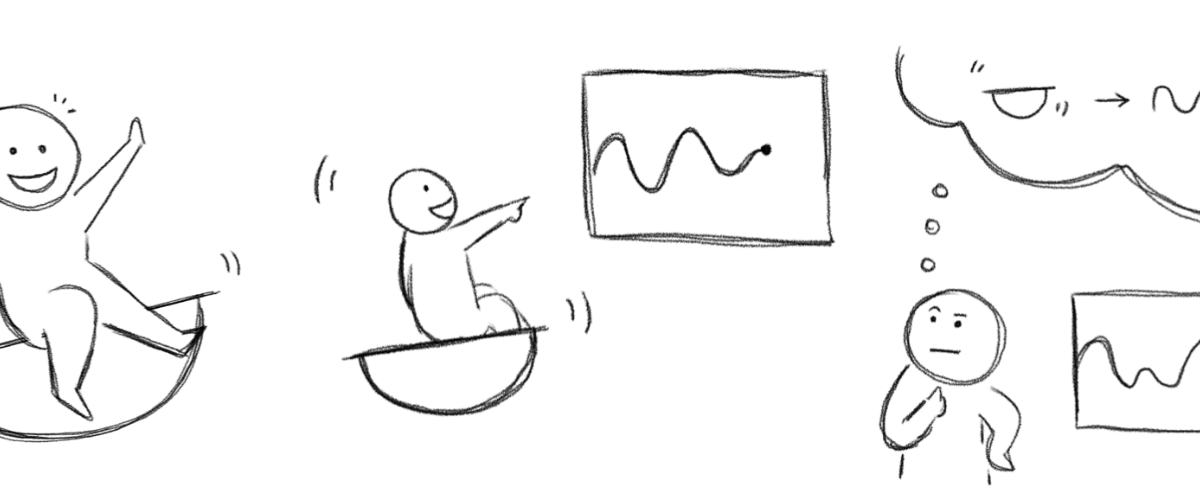
We're developing and researching an embodied-interaction design for mathematics learning. Children remote-manipulate virtual objects on a computer screen in an attempt to figure out the underlying principle of the "mystery device." The underlying principle is proportionality, a mathematical conceptual system that challenges many students. Our premise is that everyday life does not occasion opportunities for children to enact what could then serve as the meaning -- the cognitive substrate -- for what thus become challenging mathematical notions. For example, we can all intuitively gesture what "addition" means and, at a stretch, what "multiplication" means, but what does "proportion" mean or look like? Our design principle is to contrive these missing everyday occasions by creating problem-based interactions wherein students' gestural solutions literally inscribe the kinesthetic image schema underlying a conceptual metaphor of the targeted notion*, such as proportional growth. If we physically support students in enacting the ambidexterous performance of proportional progression, they may develop and articulate strategies for enacting this physical coordination; if we further interpolate into the learning environment a set of mathematical symbolic artifacts (a Cartesian grid, numerals, etc.), then students may be able to mathematize these emerging strategies in the form of quantitative propositions. Indeed, this is what we are seeing in our emprirical data from 20 interviews with Grade 4-6 students, who particiapted either in individual or paired interviews.

*The EDRL embodied-design principle.


Paradigmatic Didactical Mathematical Problematic Situations

In collaboration with Betina Zolkower, Ph.D., Brooklyn College, CUNY.
AERA 2009

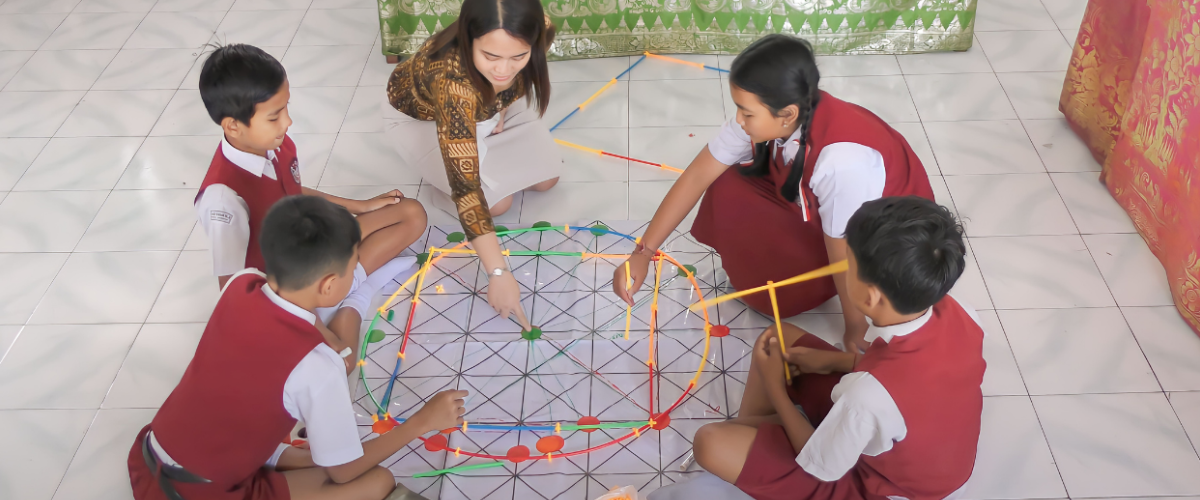
In the PDMPS project, we are implementing and researching an experimental design for pre-service teachers and future education researchers enrolled in graduate-level college courses on mathematics cognition, learning, and instruction. Central to this design are selected 'paradigmatic didactical-mathematical problematic situations,' i.e., unique activities evoked as contexts for collaborative inquiry into the epistemology, pedagogy, and practice of mathematics as well as into subject matter content. Our data include rich documentation from both the college classroom and the placement classrooms, where the student teachers are trying out the same problems. Building on functional-grammar analysis techniques, we are evaluating the conjecture that the curriculum's value lies in the authenticity of the multi-disciplinary pragmatic approach it fosters in future teachers. We are also interested in potential tradeoffs inherent to a problem-focused curriculum.


Seeing Chance: Fostering Student Implicit Knowledge Towards Fluency in the Domain of Probability and Statistics

Seed funding: National Academy of Education/Spencer Foundation postdoctoral fellowship to Abrahamson, 2005-6 [$65k].
Conference Proc.: AERA2007PMENA2007a, PMENA2007b, AERA2008ICLS2008, ICME2008, AERA2009SRTL2009, PMENA2009, ICLS2010,   
Journal Articles: Cognition & Instruction , Ed. Sudies in Math. (+ QuickTime), For the Learning of Mathematics,
Int. Elec. J. of Math. Ed.Int. J. of Comp. for Math. Learning: article
Int. J. of Comp. for Math. Learning: snapshot, ZDM,
CreativeIT interactive
J. of the Learning SciencesJ. of Stat. Ed., Mathematical Thinking and Learning (+ QuickTime)
Chapters: Stein&Raudenbug(Eds) , Chernoff(Ed.)

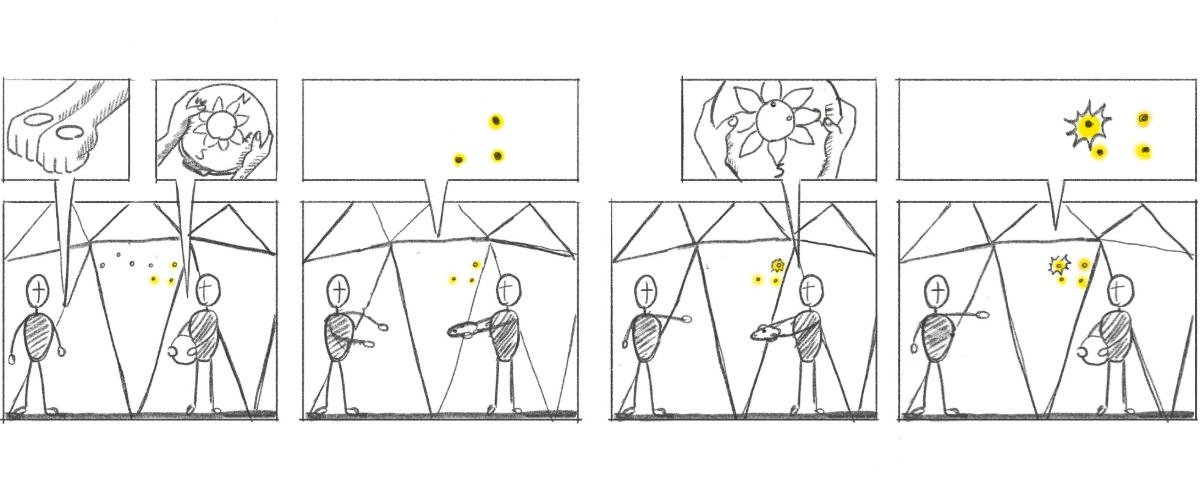
Consider this paradox. On the one hand, there is growing evidence of very young babies' capacity to draw mathematically sound infererence from situations involving random events. On the other hand, school students' manifest chronic challenges in learning probability concepts. What's going on? Well, perhaps school is not capitalizing on students' innate or early-developed capacity. In this project, we created learning materials --  using both traditional media (marbles, cards, crayons) and computer-based modules (NetLogo simulations) -- that, on the one hand, enable studetns to draw on the same intuitions that we know babies have, but on the other hand lend themthelsves to elaboration into mathematical models. We thus honed the tension between inference from intuitive perceptual judgments of naturalistic situations and inferences from analytical models of these same situations. We worked with students in Grades 4-6 as well as with 7th graders and undergraduate and graduate students. Across the gamut, we found, students were capable of leveraging the same sound intuitions when looking at the situation in non-analytical ways but were challenged by the rationale of the formal analysis. The challenge, it turned out, was centered on perceptual construction of random events. Namely, whereas mathematical analysis contrues compound events as classes containing the combinatorial expansion (e.g., the pair "Heads, Tails" is double as likely to occur than "Heads, Heads", because the former event has two permutations), intuitive views of the source situations construes the compound events as holistic instances with probabilistic "intensity" and no reference to order (it "feels" more likely but we're not sure why). These felt "intensities" are difficult or even impossible to inscribe and thus make use of in ways that promote understanding, if you do not accept the principle of combinatorial expansion. Yet, once students succeeded in viewing a specially arranged assembly of the sample space as holistically expressing their intuitive inference regarding the source situation, they were willing retroactively to accept the procedure of combinatorial analysis. We named this sudden appropriation of the mathematical model a "semiotic leap," because at those moments new signs were born in which disciplinary structures first bore the intuitive meanings. The model signified the intuition. (see previous and current design)


The Real World as a Trick Question: Mathematical Modeling, Knowledge, and Assessment

UCB Committee on Research: Junior Faculty Research Grant, 2006-7 [$6k]
AERA 2007

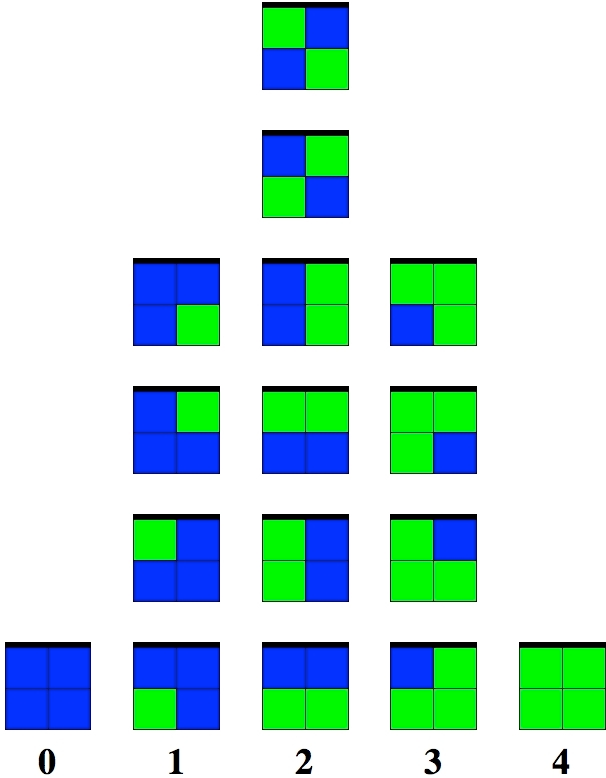
Study consisted of conducting and analyzing probability-related clinical interviews with college students majoring in statistics to explore issues of intuitive reasoning. 24 undergraduate/graduate students enrolled in mathematical programs participated in one-to-one interviews as part of a design-based research study of the cognition of probability. The students were asked to estimate outcome distributions of a very simple randomness generator consisting of an exposed bin full of marbles, half green and half blue, and a scooper -- a 2-by-2 array of concavities -- for drawing out exactly four marbles from the mix. This array formation (4-block) featured also in combinatorial-analysis materials and computer-based simulations of the probability experiment. Central to the design is the combinations tower, an assembly of the 16 unique outcomes in the form of a 1:4:6:4:1 "picto-barchart," i.e., with the outcomes themselves, not just stark columns as in regular histograms. All students said that the relatively most common experimental outcome should have 2 green and 2 blue marbles, but only 10 students initiated combinatorial analysis as a means of warranting their guess, of whom only 4 conducted it successfully. For all students, the combinations tower constituted a context for coordinating between the sample space of the stochastic device and distributions of actual outcomes in experiments with this device. I argue for the utility of guided, situated problem solving for the learning and consolidation of probability concepts.


Handing Down Mathematics: The Roles of Gesture in the Design, Teaching, and Learning

Analyzing videotaped classroom interactions to understand the roles of gesture in the design, teaching, and learning of mathematics.

PMENA2004-Embodied-Spatial-Articulation
PMENA2007-Handling-Problems


Embodied Design: Framework for Creating Materials and Activities


Distributed Learning in Practice and Theory

CSCL2007

Tackling distributed-learning theoretical models from a complexity-studies perspective to frame the design and implementation of agent-based models and their extensions that support participatory simulations in mathematics classrooms; Using agent-based modeling to study and develop theoretical models of group learning.


The Three M's: Imagination, Embodiment, and Mathematics

JPS 2006-abstract

Research into the mechanisms and potential agency of imagination in mathematical reasoning.


Fractal Village (Sneha Veeragoudar Harrell's dissertation work)

Journal of Virtual Worlds Research

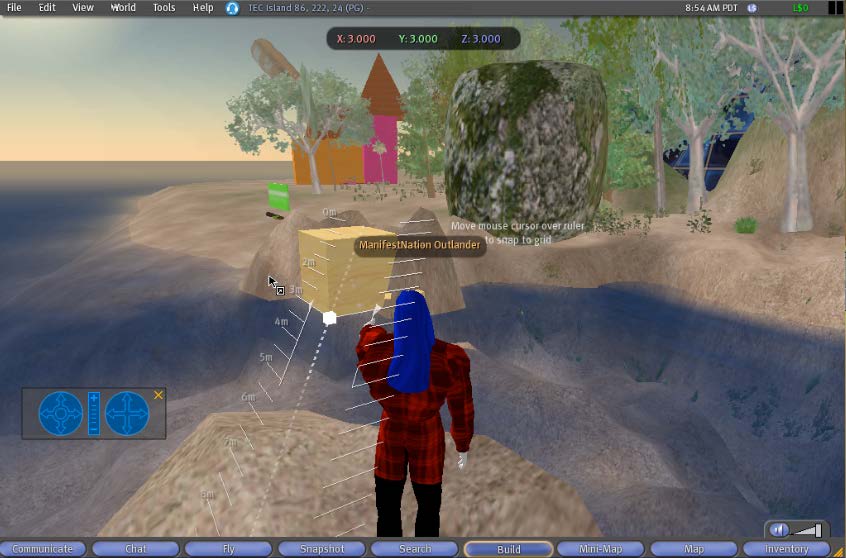
Design-based research utilizing a critical and constructionist pedagogical philosophy in an alternative high school setting to study mathematical agency, computational literacy, and identity. 
AttachmentSize
Abrahamson2011Chap.pdf338.68 KB

User login